Boston Dynamics gives its Atlas humanoid robot wheels in new agility tests
Boston Dynamics attached wheels to the feet of its Atlas humanoid robot to test how combining physics-based control with machine learning improves movement.
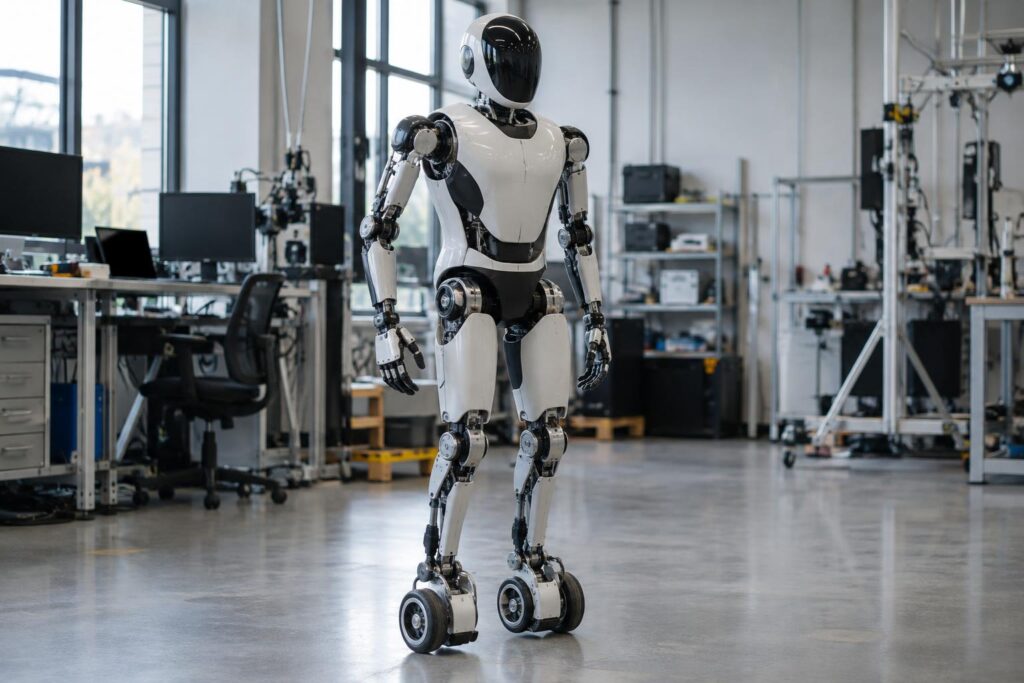
Boston Dynamics has shared a new video showing its Atlas humanoid robot moving around on wheels. The company stresses that this setup is strictly a research testbed rather than a commercial product. Engineers wanted to test the limits of the robot’s actuators and see how it handles unstructured real-world environments.
Blending Physics and Machine Learning
The experiment combined classical model-based motor control with whole-body reinforcement learning. This mixture helps the machine maintain stability across uneven ground. While traditional physics-based controls handle baseline stability, the learning software helps the robot react to unexpected disturbances in real time.
The hardware changes required to add the wheels were minor. Engineers used a custom adapter to mount a standard scooter rim onto the robot’s existing ankle actuator. Software adjustments were similarly simple because the control system treated each wheel as an ankle capable of continuous rotation.
Future Tests and Industry Impact
Next, the engineering team plans to study how the robot’s control policy responds to failed actuators. This research helps address the ongoing debate in robotics over whether humanoid machines should use legs, wheels, or a combination of both for getting around spaces designed for humans.
How does this story land?
One tap per reader.
Quick poll
Are wheels a better choice for humanoid robots than legs?
One vote per reader. Results show after you vote.
Ask this story
Answers are written by AI from this story only. They can be wrong.