AGIBOT G2 Humanoids Complete 1,730 Tasks in 24-Hour Retail Trial
Six AGIBOT G2 wheeled humanoid robots performed 1,730 tasks during a live 24-hour convenience store trial in Shanghai, with four passing their final assessment.
Humanoid Robots Tested in Live Shanghai Store
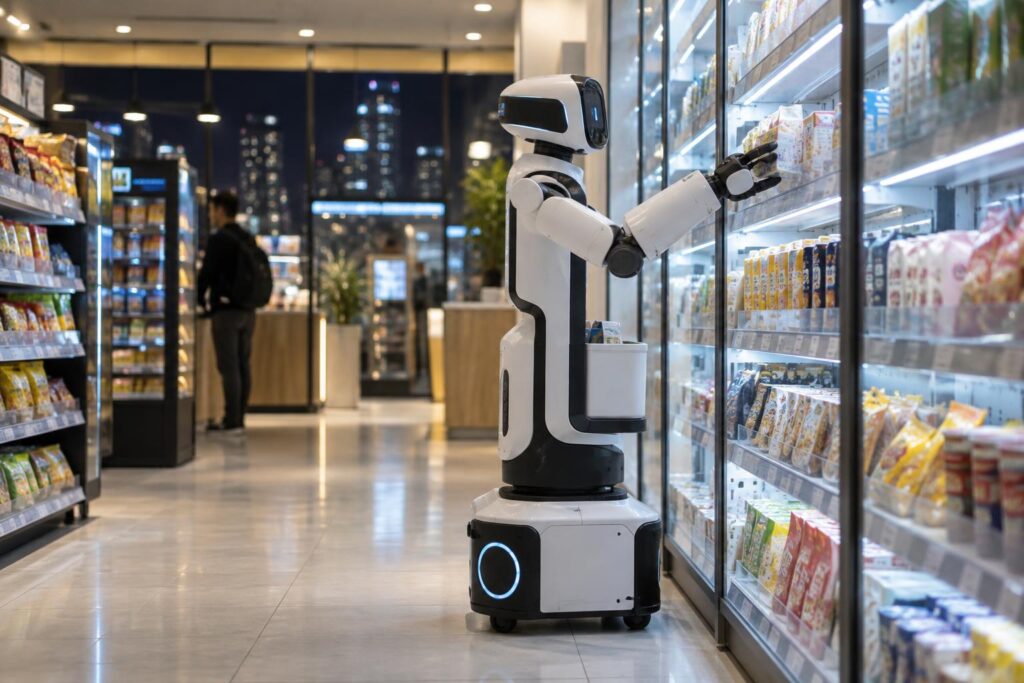
Six wheeled humanoid robots completed a 24-hour real-world test inside an operating convenience store in Shanghai’s Xuhui District. The trial ran from 10 a.m. on November 2 to 10 a.m. on November 3 and was broadcast live online to more than two million viewers. Developed by AGIBOT, the G2 robots performed 1,730 total tasks across four shifts, covering busy lunch periods, evening hours, overnight operations, and morning rushes.
The test evaluated how artificial intelligence works inside physical machine bodies during customer service and daily store duties. The robots handled 683 customer service interactions, 369 product pickups and deliveries, 277 shelf inspections and restocking tasks, 147 coffee orders, 128 table-cleaning duties, and 126 food servings. Evaluators gave the robots specific challenges, such as telling apart regular and sugar-free sodas, reorganizing misplaced chewing gum, and navigating around people or boxes blocking store aisles.
How Real-World Retail Tests Precision
Operating inside a live store presents dynamic challenges that controlled lab environments lack. Customers move around aisles, items change positions, and product packaging varies. Small physical tasks require precise control. For example, grabbing a bag of candy at an awkward angle without disturbing surrounding items or handling soft food without damaging it tests fine motor skills and sensor accuracy.
The G2 robots used real-time vision systems rather than fixed software coordinates to spot misplaced items and return them to correct locations. Restocking robots automatically detected empty shelf gaps and filled them without direct human prompts. Cleaning units successfully distinguished actual liquid spills from countertop visual patterns and selected the right cleaning tools.
Centralized AI Coordinates Fleet Learning
AGIBOT used its Genie Master framework to coordinate the robot fleet. The system relies on an Embodied Execution Protocol to link task planning, physical action, and operational feedback. Genie Master assigns duties based on store conditions and individual machine capabilities. When a robot completes or fails a task, the result is sent back to the central system for analysis.
This framework allows the software to retain experience in long-term memory. Successful adjustments made during live operations can be converted into training data to refine how the robots move and act. During quieter overnight hours, AGIBOT used operational feedback to give the G2 robots extra practice on complex tasks that required precise physical manipulation.
What Failed and What Comes Next
Out of the six robots tested, four passed their final performance assessment, while two failed to meet all evaluation criteria. Assessment standards included total time on duty, task completion success, response speed, customer feedback, and how well machines handled unexpected errors.
The store test marked the conclusion of AGIBOT’s AI WAVE technology showcase, which began on October 22. The company plans to expand testing across other commercial roles and settings. Future trials will focus on improving robot reliability, identifying which capabilities can transfer between different work environments, and scaling fleet operations.
How does this story land?
One tap per reader.
Quick poll
Would you buy from a robot store?
One vote per reader. Results show after you vote.
Ask this story
Answers are written by AI from this story only. They can be wrong.