New AI model accelerates laser physics calculations by 250 times
Scientists have created an artificial intelligence model that speeds up complex laser physics simulations while maintaining high accuracy.
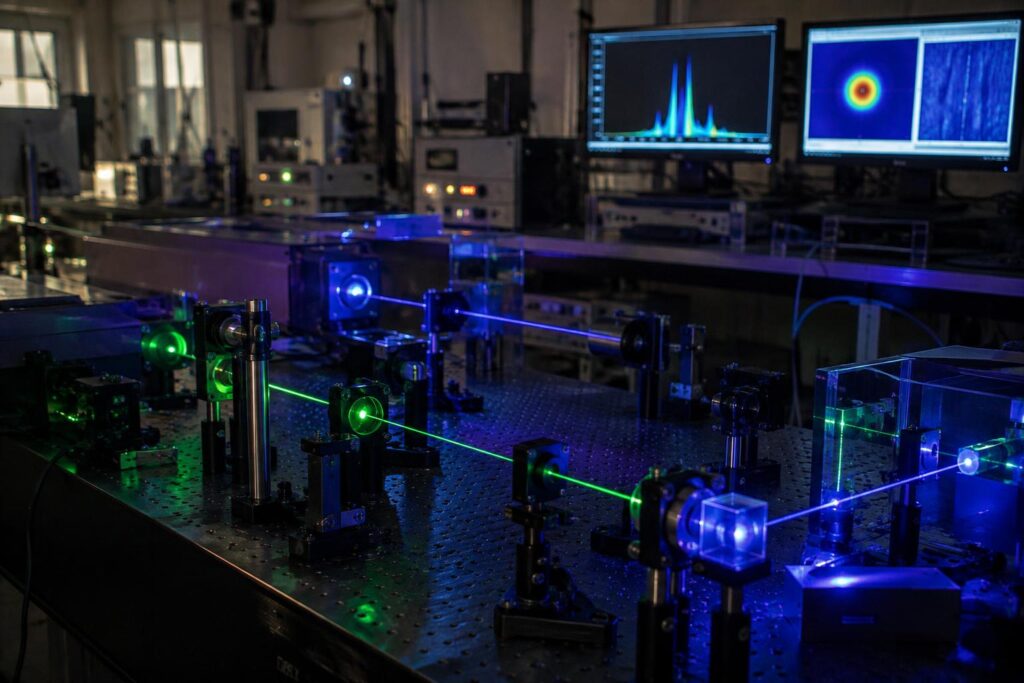
Researchers from Stanford University, UCLA, and SLAC National Accelerator Laboratory have developed a new artificial intelligence system designed to simulate laser physics. The technology relies on deep learning to bypass traditional computing bottlenecks. It replicates conventional simulation results much faster while keeping high accuracy across various laser pulse shapes.
Tackling a major computing bottleneck
The innovation focuses on second-order nonlinear optics, which are interactions that occur when light waves exchange energy inside special crystals. These processes allow scientists to change light frequencies and control laser pulse shapes. Large scientific facilities use these techniques to generate intense X-rays. Traditionally, simulating these interactions requires solving complex equations using a method called the split-step Fourier method. This calculation alone takes up about 95 percent of the total processing time in a complete laser simulation.
How the artificial intelligence model works
To solve this problem, the team built a model using a recurrent neural network known as long short-term memory, or LSTM. Instead of repeatedly converting data between time and frequency domains like standard methods, the network works directly with a compressed representation of frequency characteristics. When tested using graphics processing units, the system reduced average calculation times to just a few milliseconds per simulation. This delivers a massive speed boost without losing accuracy.
Potential uses in real-time laser control
The researchers believe this technology could eventually connect directly to operating laser systems. By combining trained neural networks for different physical processes, scientists could create digital twins, which are virtual models that mirror real equipment. This could help researchers monitor experiments and adjust laser settings in real time.
How does this story land?
One tap per reader.
Quick poll
Will AI speed up physics breakthroughs?
One vote per reader. Results show after you vote.
Ask this story
Answers are written by AI from this story only. They can be wrong.