MIT engineers design water-resistant microneedles to vaccinate farmed fish
Researchers at MIT and the USDA developed food-grade, water-resistant microneedles made from silk and shellac to safely vaccinate farmed fish underwater.
Addressing the Disease Challenge in Aquaculture
Farmed aquatic animals now exceed wild-caught aquatic animals in global food production by weight. As the world population grows, aquaculture plays a vital role in providing essential protein and nutrition. However, disease outbreaks frequently cause heavy losses in fish pools and ponds. To prevent these losses, farmers rely on various vaccination strategies, but each method comes with significant drawbacks.
Adding vaccines to fish food or immersing fish in treated water requires large quantities of medicine and often fails to reach every animal. The most effective vaccination method currently used relies on metal needles. This process requires workers to sedate fish, remove them from the water, and inject them manually on a conveyor belt. It is labor-intensive, costly, stressful for the animals, and dangerous for workers who face the risk of accidental needle pricks or cross-contamination.
Adapting Silk and Shellac for Underwater Delivery
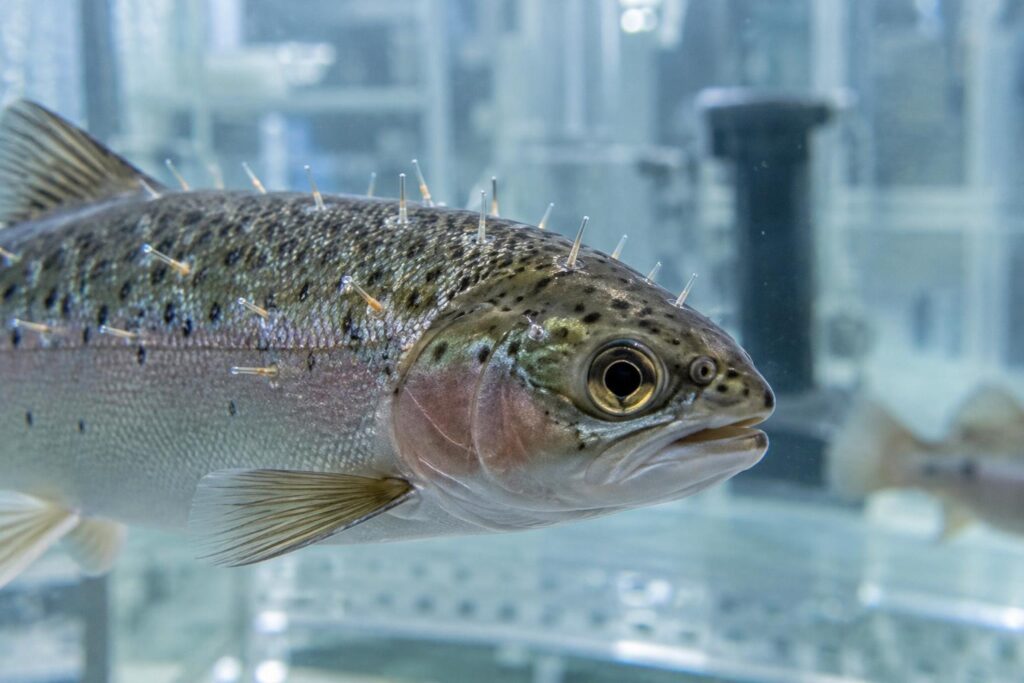
Researchers at the Massachusetts Institute of Technology and the U.S. Department of Agriculture designed a novel delivery system to solve these problems. The team adapted a silk-based platform previously used for plant nutrients into water-resistant microneedles. Because standard silk dissolves too quickly when exposed to water, the researchers added a thin layer of shellac, a natural insect-secreted resin commonly used in food coatings and pills. This moisture barrier keeps the microneedles intact until they lightly penetrate the skin of a fish.
The tiny, single-use needles attach to the skin of swimming fish and safely decompose over time. Laboratory tests showed that the system can successfully deliver different types of treatments, including bacterial and DNA vaccines. Furthermore, the microneedles remained stable in dry conditions for weeks, reducing the need for strict refrigeration in remote farming regions. This technology allows farmers to protect very small juvenile fish that are typically too delicate for traditional metal needles.
What This Means for Builders and Investors
For investors and builders in the agtech and biotechnology sectors, this innovation highlights the growing commercial potential of advanced biomaterials in food production. As global demand for sustainable protein rises, aquaculture technology represents a rapidly expanding market. Solutions that reduce labor costs, improve animal welfare, and lower mortality rates without harming the environment address major operational bottlenecks for fish farmers.
While the new microneedle system shows strong early promise, it requires further development before it can be scaled for commercial use across global fish farms. Researchers must refine manufacturing processes and test the technology in larger real-world environments. Investors should monitor how academic teams transition these lab-scale biomaterial platforms into commercially viable products for the agricultural market.
What to Watch Next
Researchers plan to continue testing the stability and release rates of various drug cargos using the silk-shellac microneedle platform. Future developments will focus on scaling up the manufacturing process to produce large batches of the single-use devices affordably. Observers should look for subsequent field trials in commercial aquaculture facilities to see how the technology performs under standard operational conditions.
How does this story land?
One tap per reader.
Quick poll
Will microneedles replace traditional fish vaccination methods within a decade?
One vote per reader. Results show after you vote.
Ask this story
Answers are written by AI from this story only. They can be wrong.