Forgotten Heavy Neutrino May Explain Why Matter Survived the Big Bang
Physicists suggest a long-overlooked heavy particle could solve the mystery of why matter outlived antimatter in the early universe.
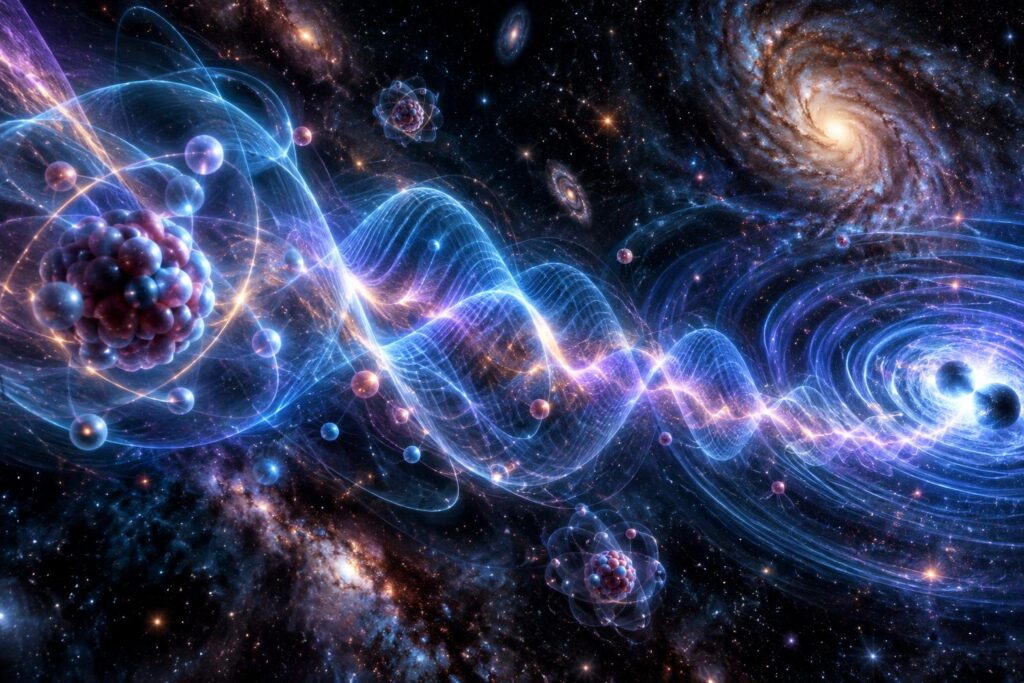
Researchers propose that a little-known particle could answer a major question in physics: why the universe contains matter instead of nothing at all. Scientists believe the early cosmos produced nearly equal amounts of matter and antimatter. When these opposing forces meet, they destroy each other and release energy. If their quantities had been exact, all matter would have vanished.
A Long-Ignored Particle Steps Up
Scientists from the University of Southampton and the Indian Institute of Technology Kanpur examined a relative of the neutrino known as a decoupled heavy neutrino. Physics experts previously dismissed this particle because it interacts very weakly with other matter. However, calculations show its exceptionally long lifetime allowed it to survive as the universe cooled.
This delayed decay meant the particle temporarily dominated the energy density of the young cosmos. That brief period of control shifted the temperature conditions when fundamental particles interacted with their antiparticles using the Higgs boson. This shift helped create the imbalance that favored matter over antimatter.
Clues in Space-Time Ripples
The theory also suggests the heavy neutrino changed how the early universe expanded. Researchers state this shift could leave detectable patterns in primordial gravitational waves, which are ripples in space and time. Detecting these ancient signals might allow scientists to test the new theory.
How does this story land?
One tap per reader.
Quick poll
Will gravitational waves ever prove how matter survived the Big Bang?
One vote per reader. Results show after you vote.
Ask this story
Answers are written by AI from this story only. They can be wrong.