Electric Motors Mimic Muscle Coordination to Power Better Robots
Researchers built a physical model using electric motors to simulate muscle movement, showing coordination can emerge naturally without complex computer control.
Human muscles adapt smoothly to changes in load without requiring conscious thought. Inside biological tissue, tiny molecular motors called myosin grab and release protein cables to create movement. While this biological system is well studied, exactly how these tiny parts coordinate their actions remains a complex question. Scientists at the University of Bristol sought to understand this process by building a model using ordinary electric motors instead of biological chemistry.
Simple Motors Share a Mechanical Backbone
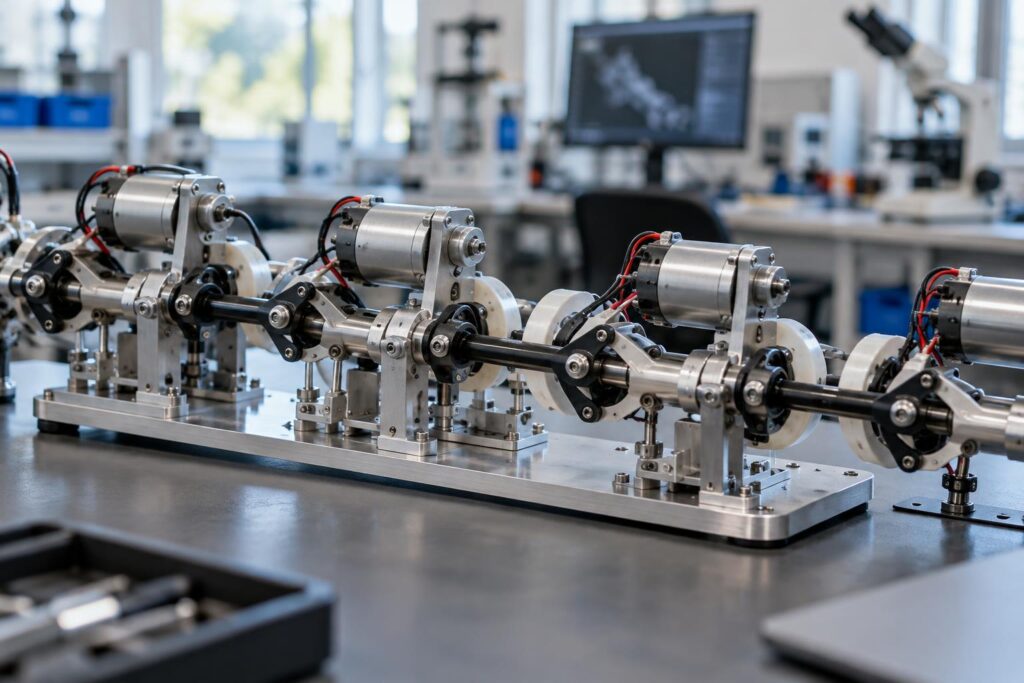
The research team created a mathematical model and a tabletop device to test how simple force-producing units interact. Instead of trying to replicate complex biochemical cycles, they used rotating motors that connect briefly to a shared moving backbone. The motors push against a thick fluid to create resistance similar to biological loads. When disconnected, each motor acts independently. When connected, the shared backbone transmits mechanical effects from one unit to the next, allowing them to coordinate without direct communication.
Spontaneous Coordination and Robotics Applications
The physical setup demonstrated that coordinated behavior can emerge naturally as a property of the mechanical design rather than through continuous computer programming. As physical resistance increased, the motors spontaneously adapted their participation and speed, mirroring patterns found in biological experiments. Researchers suggest this finding could help build simpler actuators for robotics, potentially removing the need for fragile sensors and complex control algorithms in soft robots and artificial muscles.
How does this story land?
One tap per reader.
Quick poll
Will biomimetic designs replace traditional robotic controls in the near future?
One vote per reader. Results show after you vote.
Ask this story
Answers are written by AI from this story only. They can be wrong.