Scientists Map Over a Million Cells to Reveal How Mammals Grow
A new study tracks the family history of over a million cells to create a detailed blueprint of how a mouse embryo develops over time.
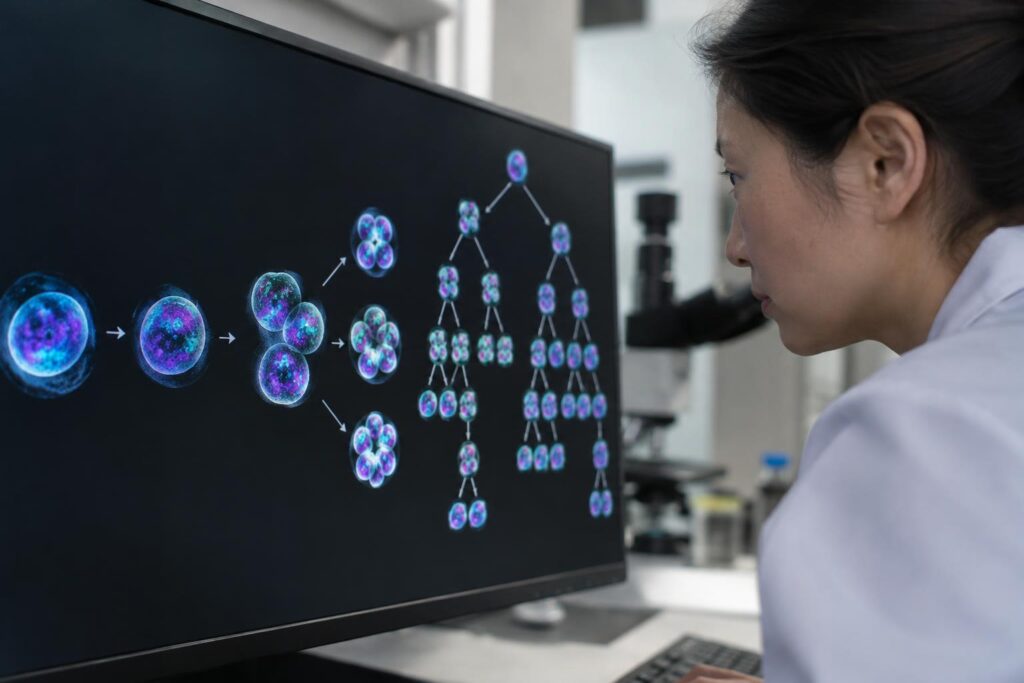
For many years, researchers could only study embryonic development through isolated snapshots. They could see a developing brain or a forming heart at specific moments, but watching the entire process unfold remained out of reach. Now, a new study offers one of the most detailed views yet of how a mammal is built, cell by cell.
Tracing Cell Lineages
Researchers in the lab of MIT Professor Jonathan Weissman used a technology called PEtracer to track the family history of more than a million cells in mouse embryos. The system works like a flight recorder inside a cell, making small and heritable changes to DNA as cells divide. By reading these changes later, scientists can work backward to reconstruct a family tree for the cells. This approach allowed the team to combine cell lineage data with information about gene activity and cell location.
Implications for Disease and Biology
Understanding the complete blueprint of development could help researchers pinpoint where and when processes go wrong in birth defects. In cancer, a similar approach could help scientists trace when cells acquire traits like treatment resistance or the ability to spread. The work may also aid stem cell research by revealing the precise sequence of cell states needed to create mature cell types.
A Recipe for Life
The genome provides the basic ingredients for an organism, but it does not supply the instructions for how those parts are used over time and space. This new developmental map begins to fill in those missing details, offering researchers a comprehensive resource to study how a single fertilized egg builds a complex animal.
How does this story land?
One tap per reader.
Quick poll
Will cell lineage mapping soon unlock new cancer treatments?
One vote per reader. Results show after you vote.
Ask this story
Answers are written by AI from this story only. They can be wrong.