New Physics Study Shows Rapidly Spinning Black Holes Might Split in Two
A theoretical study reveals that extreme rotation could allow a black hole to divide, challenging long-held rules of thermodynamics.
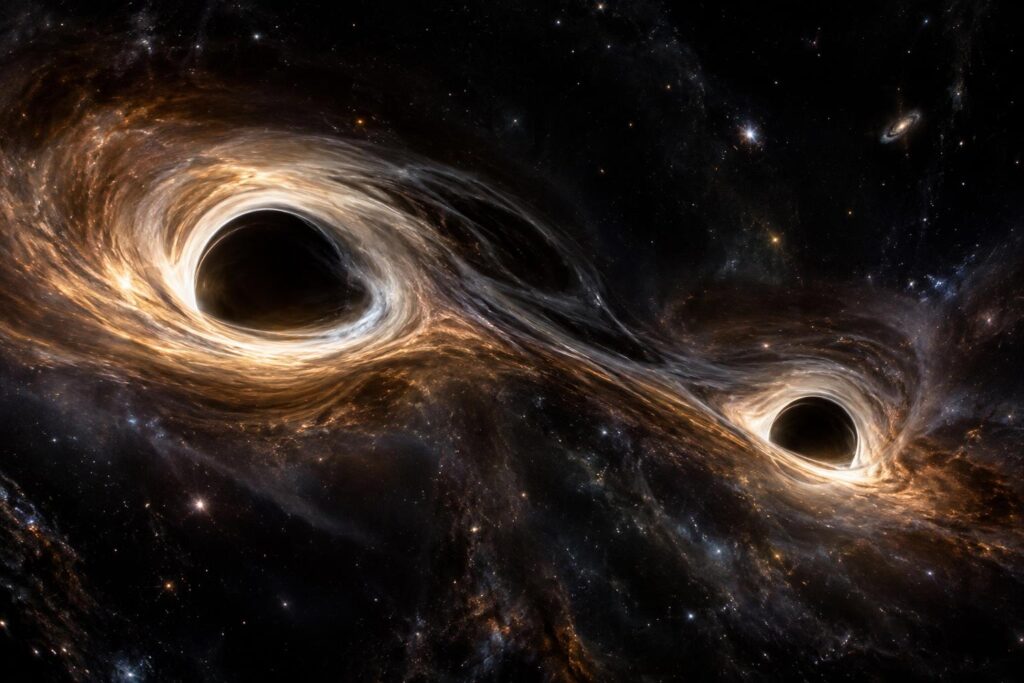
Black holes are famous for colliding and joining together, but recent theoretical work explores whether the reverse process could happen. Physicists investigating the laws governing these massive objects found that a single black hole might theoretically divide into two smaller ones under extreme conditions.
The Thermodynamic Barrier and Rapid Rotation
Normally, physics prevents black holes from breaking apart. Thermodynamics, the branch of science dealing with energy and heat, relies heavily on a concept called entropy. Entropy measures the microscopic arrangements of a system. For a non-rotating black hole, dividing into two smaller entities would lower its total entropy. This reduction makes the split thermodynamically unfavorable.
However, researchers discovered that extreme speed changes this picture. When a black hole spins exceptionally fast, it can potentially bypass the usual rules restricting division. Yet, another challenge remains. The newly formed black holes must move apart quickly to avoid crashing back together. Calculations show this separation is only plausible if the original black hole rotates near its maximum possible rate.
Exotic Dimensions and Future Detection
Scientists also examined scenarios involving extra dimensions of space beyond our standard three. In these theoretical models, black-hole-like objects can become unstable and fragment, sometimes making the split thermodynamically favorable if one resulting object is much smaller than the other.
Researchers cannot yet calculate the exact probability of such an event because it depends on how gravity operates beyond Einstein’s established theories. Small primordial black holes, which formed in the early universe, might be more susceptible to splitting than massive astrophysical ones. Scientists hope to indirectly spot evidence of tiny fragments using gamma-ray telescopes.
How does this story land?
One tap per reader.
Quick poll
Will scientists ever detect evidence of a black hole splitting?
One vote per reader. Results show after you vote.
Ask this story
Answers are written by AI from this story only. They can be wrong.