New Lumina Supercomputer Simulation Recreates Universe’s Dark Ages
Physicists have unveiled Lumina, a powerful new simulation tracking the early universe's evolution across two billion years.
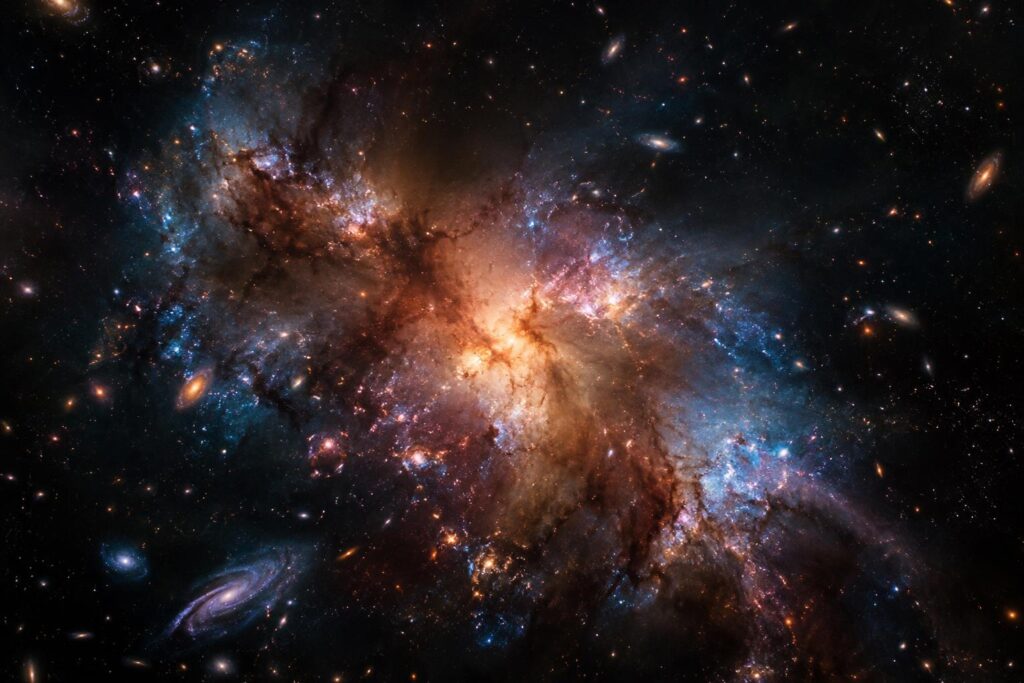
Following the Big Bang, the universe expanded and cooled, causing particles to form electrically neutral hydrogen. This accumulation blocked radiation, plunging the universe into a cosmic dark age roughly 380,000 years later. Researchers from MIT, Harvard University, and other institutions have now introduced Lumina, a high-resolution computer simulation detailing how galaxies, stars, and other structures emerged from this early period over two billion years.
Lumina spans a vast region of the early universe, covering 500 megaparsecs, or about 1.6 billion light-years. Within this volume, the simulation tracks dark matter, gas, stars, and radiation while zooming down to the scale of individual galaxies. It captures two major cosmic transformations: hydrogen re-ionization, driven by ultraviolet light from early stars and galaxies, and helium re-ionization, fueled by energetic supermassive black holes. This marks the first time a simulation has captured both processes simultaneously across such a massive scale.
Scaling Cosmic Computation
Building on previous simulation frameworks, the research team refined existing code to track galaxy formation and radiation transport across immense distances. The simulation handles half a trillion individual elements, achieving a resolution thirty times higher than previous models while covering a volume one hundred times larger. Running these calculations required immense computing power, utilizing Frontier, a major supercomputer based at the Oak Ridge National Laboratory in Tennessee. At peak capacity, the calculations relied on more than 100,000 CPU cores and approximately 15,000 GPUs.
Implications for Builders and Investors
The research team has made Lumina available to the broader scientific community. Researchers can compare the simulated data with observations from new and upcoming telescopes to better understand the processes that shaped early cosmic structures. For builders and investors tracking high-performance computing, the project demonstrates how advanced supercomputing architectures and complex software engineering can model physics at a previously unattainable scale, paving the way for further data-intensive scientific breakthroughs.
How does this story land?
One tap per reader.
Quick poll
Will advanced simulations like Lumina replace traditional telescope observations?
One vote per reader. Results show after you vote.
Ask this story
Answers are written by AI from this story only. They can be wrong.