MIT’s FLEX AI platform helps robots understand unstated human commands
MIT engineers have developed FLEX, an AI platform that lets robots interpret deeper meanings and unstated preferences from natural language commands.
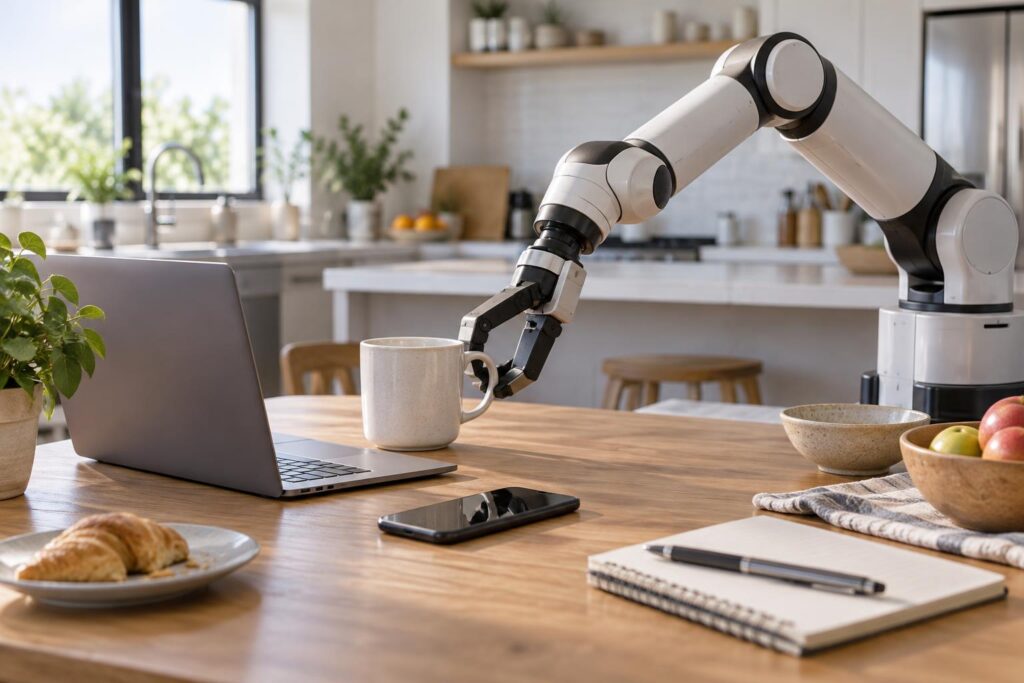
Researchers at the Massachusetts Institute of Technology and New York University have created a new artificial intelligence platform called FLEX. This system is designed to help robots interpret human instructions given in natural, conversational language. Instead of following a command strictly word for word, the robot can read between the lines to understand broader intentions and apply common sense to physical tasks.
During tests involving simulated household scenarios, a robotic arm carrying a coffee cup received a warning not to spill on a nearby laptop. By combining the instruction with a large language model, the robot deduced that it should avoid all electronic devices on the table, adjusting its path automatically without requiring further explicit instructions from the user.
How the FLEX Pipeline Operates
The FLEX system relies on a three-step process to update how a robot navigates its surroundings. The first step involves adding a specific feature to the robot’s awareness based on a human correction, such as identifying a mug to avoid. The second step utilizes a large language model to generalize from that single object, recognizing that similar items like fragile objects should also be avoided. The final step uses computer vision to clear out items that are no longer present in the room.
This approach addresses a common limitation in robotics, where users must manually program or list every single rule and obstacle. By leveraging the internet-scale training data of language models, the platform absorbs common sense patterns, such as the association between liquids and electronics failing when mixed.
Implications for Builders and Investors
For developers building autonomous agents and household robots, this research highlights a shift toward more intuitive human-robot interaction. Traditional trajectory planning relies heavily on complex mathematical inputs that everyday consumers cannot easily manage. Integrating natural language models into motion planning pipelines could lower the barrier to entry for assistive robotics.
Investors tracking the robotics sector should note the emphasis on reducing the friction of user customization. Since every home environment differs, robots that learn preferences from brief conversational prompts rather than extensive manual setup will likely find broader market appeal. Researchers plan to present their findings at the annual Conference on Robot Learning.
How does this story land?
One tap per reader.
Quick poll
Will natural language be the primary way humans control household robots?
One vote per reader. Results show after you vote.
Ask this story
Answers are written by AI from this story only. They can be wrong.