New AI model simulates sliding sand and folding proteins together
Researchers have built a single artificial intelligence system that can model many different physical processes, from flowing water to folding proteins.
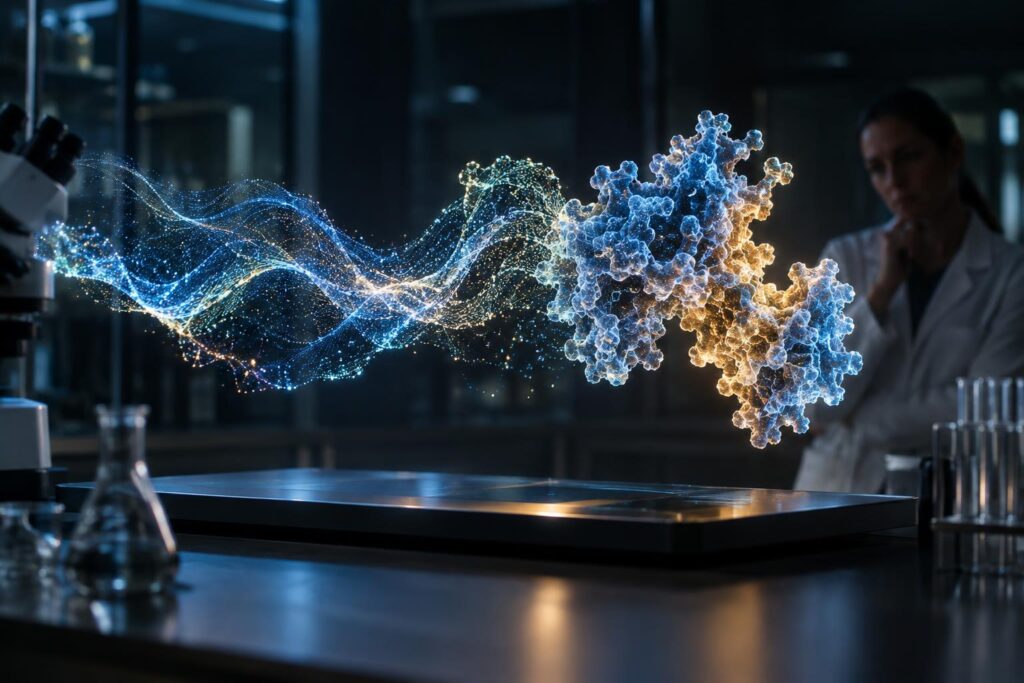
Scientists typically rely on many different software tools to simulate physical processes. Each tool uses hand-coded equations built for one specific task, such as tracking flowing water or predicting how a protein folds. Researchers from several institutions have now created a single deep-learning system that replaces this patchwork of programs with one unified architecture.
A Single System for Many Materials
The new system, called WorldParticle, can model multiple physical phenomena that usually require separate simulators. For instance, it can simulate how a fluid moves against a solid object or how sand shifts when touched by a soft robot. Instead of using preset equations for each task, the artificial intelligence learns the underlying dynamics of the materials it tracks.
The software represents materials as tiny three-dimensional particles. A neural network then takes the positions and physical properties of these particles as inputs and predicts their movement one step at a time. This approach allows the model to adapt to forces and environments it never encountered during its training phase.
Improving Speed and Efficiency
Because complex objects break down into millions of particles, the computations can become too heavy for standard models. To solve this, the research team used a technique to merge and compress particles while retaining fine details. Tests showed the system could model protein structures changing over time much faster than traditional numerical simulators, while also avoiding errors like floating particles in sand simulations.
Future Scientific Uses
The creators hope this work serves as a foundational model that works out of the box for any scenario. In the long term, they believe a unified approach could help researchers discover new materials and study complex processes across engineering, biology, and astrophysics.
How does this story land?
One tap per reader.
Quick poll
Will unified AI simulators replace traditional physics software?
One vote per reader. Results show after you vote.
Ask this story
Answers are written by AI from this story only. They can be wrong.