NASA Reveals Jupiter Uses Complex Multi-Frequency Shield Against Solar Wind
NASA's Juno spacecraft discovered that Jupiter relies on complex plasma waves and extra shock structures to block solar particles, unlike Earth.
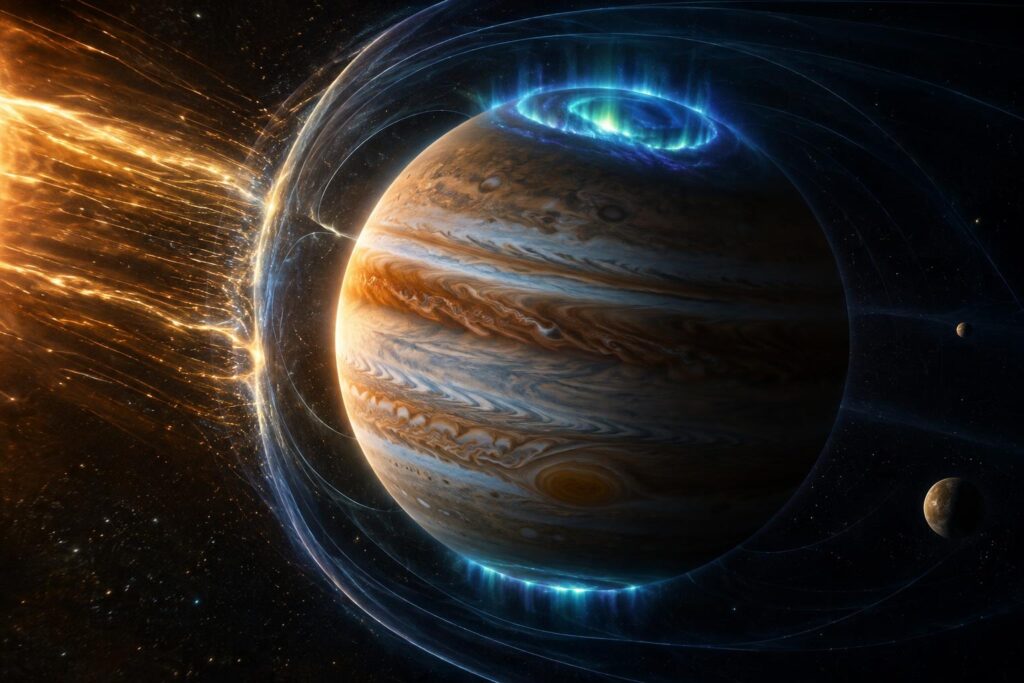
NASA’s Juno spacecraft has uncovered new details about how Jupiter handles high-energy particles from the Sun. Researchers found that the largest planet in our solar system uses a much more complex system of plasma waves and shock regions than Earth does. The findings provide the most detailed look yet at Jupiter’s bow shock, which is the invisible boundary where solar particles meet the planet’s magnetic environment.
Complex Waves and Extra Shock Structures
When the stream of charged particles from the Sun known as the solar wind approaches a planet, it hits the bow shock. At Earth, this boundary slows and heats incoming particles using plasma waves concentrated around a single frequency. Juno discovered that Jupiter relies on multiple frequencies, or harmonics, creating a richer wave pattern. This allows Jupiter’s shield to heat more particles and slow them down effectively. Additionally, Jupiter encounters smaller shock structures called shocklets before the main boundary, which help slow the solar wind even further.
A Natural Laboratory for Cosmic Physics
Researchers say these observations extend far beyond our solar system. Shock waves happen across the universe, especially around exploding stars known as supernova remnants. Because measuring cosmic shocks directly is difficult, scientists can use Jupiter’s giant bow shock as a nearby laboratory to understand how nature converts energy into heat and energetic particles. The breakthrough relies on data collected by Juno and its specialized instruments, providing a clearer picture of plasma behavior around distant planets.
How does this story land?
One tap per reader.
Quick poll
Will studying Jupiter help us understand deep space better?
One vote per reader. Results show after you vote.
Ask this story
Answers are written by AI from this story only. They can be wrong.