Scientists Recreate Big Bang Matter Using Small Oxygen Collisions
Researchers used small atomic collisions to recreate primordial matter from the earliest moments of the universe.
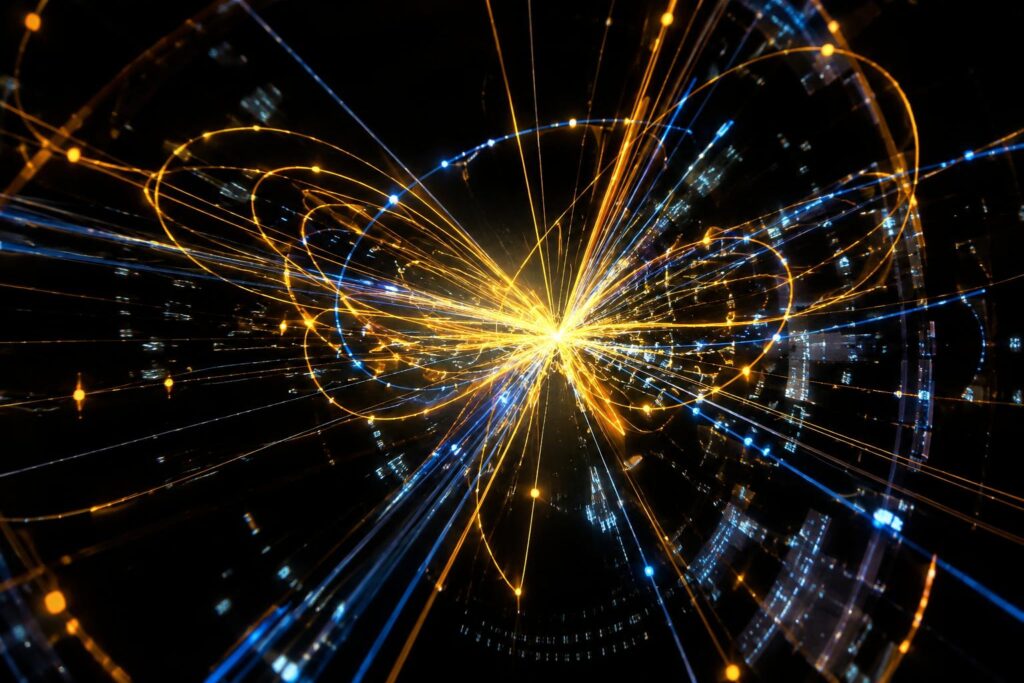
Physicists have successfully generated signs of quark-gluon plasma, an extremely dense and hot substance that filled the early universe, by smashing tiny oxygen nuclei together at nearly the speed of light. This exotic form of matter existed before protons and neutrons formed. Researchers detected this state by observing that high-energy particle streams lose energy as they travel through the collision debris.
Detecting Primordial Matter
Scientists traditionally study this plasma by crashing large gold nuclei into each other at high speeds. These massive impacts break down the boundaries of protons and neutrons, releasing the quarks and gluons inside. Because the resulting droplet of matter lasts for less than a billionth of a billionth of a second, researchers cannot view it directly. Instead, they use giant detectors to analyze particles escaping the collision.
Lowering the Energy Boundary
Recent experiments involved oxygen nuclei, which contain far fewer protons and neutrons than gold nuclei. These oxygen collisions occurred at significantly lower energy levels than previous large-scale tests. By tracking how particle jets lose energy when passing through the matter, the team established a new lower limit for the conditions needed to produce this ancient substance in smaller systems.
How does this story land?
One tap per reader.
Quick poll
Will smaller particle colliders replace massive facilities for major physics discoveries?
One vote per reader. Results show after you vote.
Ask this story
Answers are written by AI from this story only. They can be wrong.