New Space-Time Limit Discovery Could Speed Up Future Electronics
Researchers have demonstrated a fundamental space-time limit in quantum physics, showing that an electron's location and timing cannot both be known with absolute precision.
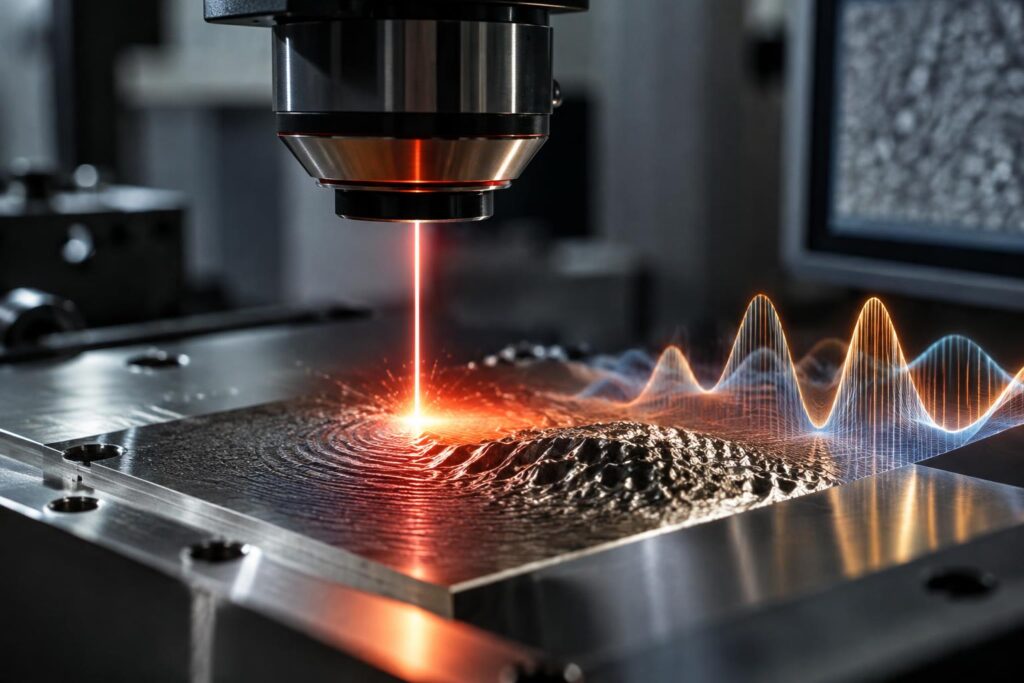
Quantum physics sets strict boundaries on what scientists can observe about tiny particles. While Heisenberg’s famous uncertainty principle restricts measuring a particle’s position and momentum at the same time, position and time have lacked that specific restriction until now. An international group of researchers has experimentally shown a new fundamental constraint known as the space-time limit. This means an electron’s location and its behavior over time cannot both be determined with arbitrary precision.
The collaborative team, involving researchers from the Regensburg Center for Ultrafast Nanoscopy and the Max Planck Institute in Hamburg, used a custom laser system to study individual electrons moving across tiny distances. By using carefully timed light pulses, the scientists watched electrons travel from a metal tip to a silver surface through a process called quantum tunneling, where particles pass through barriers normally blocked by classical physics rules.
The experiments revealed that trying to pinpoint an electron’s timing more precisely requires more energy, which causes the electron’s quantum wave packet to spread out further in space. This trade-off between spatial distribution and temporal timing highlights a core natural restriction. Understanding these ultrafast processes at the scale of attoseconds could eventually help build much faster electronic devices and advance quantum technologies.
How does this story land?
One tap per reader.
Quick poll
Will space-time limit discoveries lead to practical ultrafast electronics soon?
One vote per reader. Results show after you vote.
Ask this story
Answers are written by AI from this story only. They can be wrong.